
THE PITT SEASON 2: DR. LANGDON TAKES A RISKY MOVE IN LIFE-AND-DEATH SITUATION

In last night’s gripping episode of The Pitt, the high-stakes drama inside the Pittsburgh emergency room reached a new level of intensity. The episode centered on Lyman Payne, a patient who had driven his car into a telephone pole, arriving in the trauma bay with a dangerous neck injury: a uni-facet C4-C5 dislocation. Two of his neck vertebrae had partially slipped, causing compression on his spinal cord, leaving him unable to feel his feet and losing strength in his hands. Worst of all, his ability to breathe on his own was quickly fading.
With neurosurgery taking 15 minutes to arrive, Dr. Langdon faced a rapidly closing window of time to save his patient. The stakes were higher than ever. The situation called for a precise procedure that could either save or severely cripple the patient for life: a closed cervical reduction.
A Procedure With Huge Risks
The closed cervical reduction required applying traction to Payne’s skull, flexing the dislocated vertebrae, and physically pulling the vertebrae back into alignment. If done wrong, this procedure could lead to complete and permanent quadriplegia. Typically, this complex maneuver is only performed in emergency departments under the supervision of a neurosurgeon. However, Langdon found himself in a terrifying position—he had never performed the procedure himself, only observed it once. With no time to waste, Langdon made the life-altering decision to act.
An Unlikely Success
In a tense and dramatic moment, Langdon took the risk and performed the procedure. Within 60 seconds, Payne’s breathing began to stabilize. The procedure had worked, and Langdon had narrowly avoided a devastating outcome. When Dr. Abbott learned what Langdon had done, his only reaction was two simple words: “Brass balls.” It was a moment of unexpected praise, but also a clear recognition of the tremendous courage it took to perform such a risky, high-stakes maneuver.
This nail-biting scene has quickly become the talk of the medical world. The Pitt‘s medical accuracy has generated significant buzz, particularly on medical TikTok, where spine surgeons and ER doctors alike have shared their reactions. Many have praised the realism of the scene and the fact that the procedure shown is indeed possible, although rarely performed without a neurosurgeon present.
Real Risks, Real Stakes
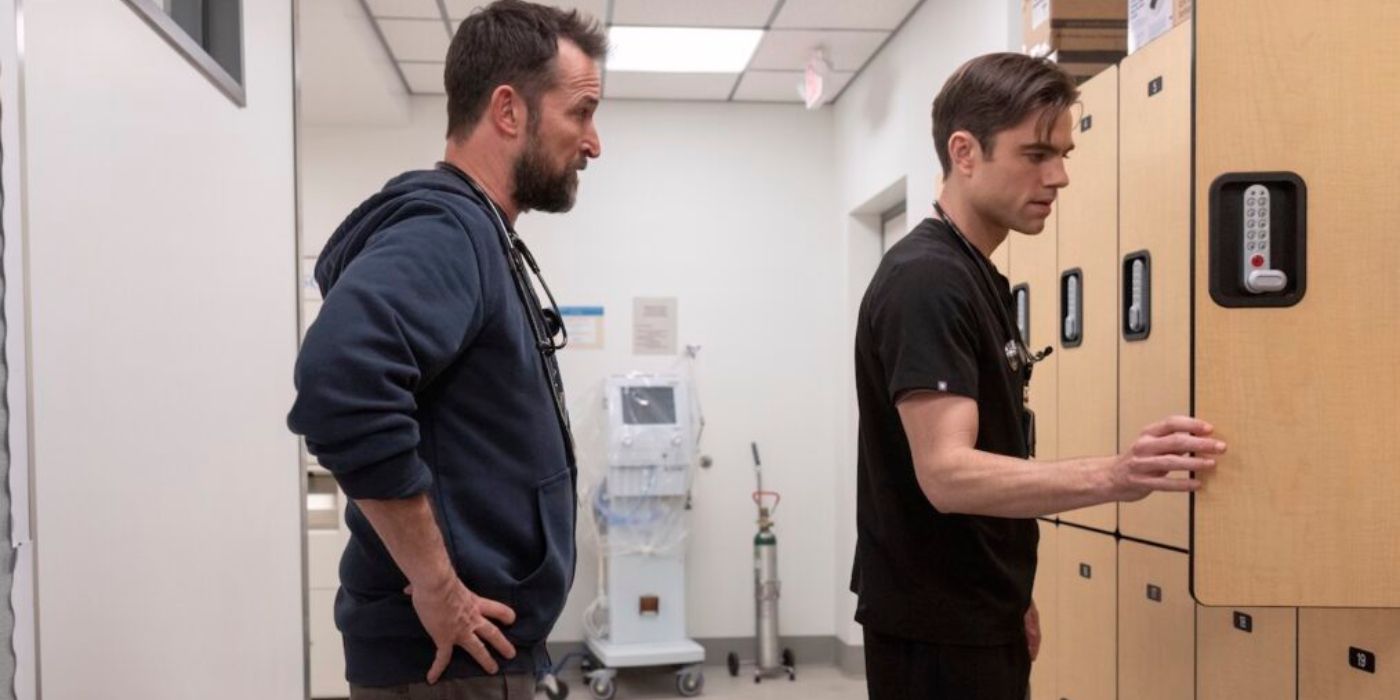
The show’s medical team confirmed that the procedure depicted in the episode is based on real-life techniques, though it comes with genuine risks—risks that were accurately portrayed. The 15-minute window before permanent spinal injury is a true concern in cases like Lyman Payne’s, and the potential for paralysis is very real.
After the intense procedure, Robby told Langdon, “Nice job,” while Abbott took Langdon aside and commented, “See, you haven’t lost it.” Still, Langdon was visibly shaken by the weight of what he had just done. Stepping outside to process the experience, he seemed to grapple with the immense responsibility of saving a life in such a critical moment.
A Defining Moment for Dr. Langdon
This scene in The Pitt serves as a defining moment for Dr. Langdon’s character. It’s not just about the procedure—it’s about his growth as a doctor, the risks he’s willing to take, and the internal conflict he faces when confronted with life-and-death decisions. Langdon’s willingness to step up in the absence of a neurosurgeon speaks to his growth and the intense pressure that comes with working in an emergency room, where lives hang in the balance.
As the season progresses, it’s clear that The Pitt is not shying away from exploring the high-risk, high-reward world of emergency medicine. And with performances like this, the show continues to captivate its audience with emotional intensity, medical realism, and unforgettable characters.


