
A Streetwise Kid from Queens and a Polished Harvard Graduate: How Michael Che and Colin Jost Became the Most Unlikely Duo in Weekend Update History
On paper, it sounded like the setup to a disaster movie.
Put them together behind the same news desk, live on national television, and the prediction from skeptics was simple:
It wouldn’t last.
But instead of clashing, Michael Che and Colin Jost turned that contrast into comedic gold—transforming the desk of Saturday Night Live’s legendary Weekend Update into one of the most explosive and unpredictable comedy pairings of the modern era.
And behind all the televised insults, savage punchlines, and brutal on-air betrayals lies a truth that fans rarely see:
When the lights go off, they’re still just two guys backstage, patting each other on the shoulder and asking, “So… what are we drinking tonight?”
A Duo That Looked Like a Recipe for Chaos
When Michael Che joined Weekend Update, the show already had a long tradition of anchor duos—some successful, others forgettable.
But pairing him with Colin Jost introduced a dynamic rarely seen on television:
Street-smart cynicism meeting polished sarcasm.
Che brought edge—raw, observational humor forged in real-life hardship. Jost brought structure—carefully crafted wit shaped by years of academic rigor.
Their differences were obvious from day one.
Che delivered jokes with laid-back menace.
Jost delivered punchlines with controlled confidence.
Together, they created something neither could produce alone.
The Art of Publicly Destroying Your Best Friend
If there’s one thing audiences have come to expect from the duo, it’s cruelty—delivered with a smile.
Segment after segment, viewers watch as Che launches ruthless jokes at Jost’s privileged background.
Harvard.
Wealth.
Family connections.
Nothing is off-limits.
And Jost responds the only way he can:
By enduring.
Smiling.
And occasionally firing back with equally savage insults.
Their infamous “joke swap” segments have become some of the most anticipated moments on Saturday Night Live.
The rules are simple:
They write jokes for each other.
They read them live.
They don’t see them beforehand.
And they’re not allowed to refuse.
What happens next is controlled chaos.
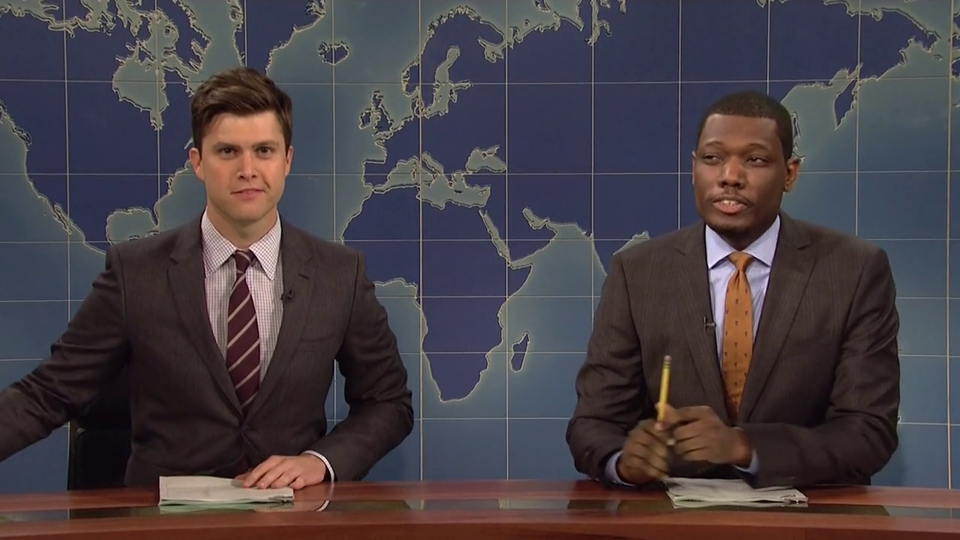
Michael Che: Teaching the World to Laugh at Darkness
Much of Che’s comedic identity revolves around confronting uncomfortable realities.
Race.
Inequality.
Absurdity in politics and culture.
He doesn’t avoid dark topics—he runs straight into them.
And he drags Jost along for the ride.
Time after time, Che forces his co-anchor to deliver jokes so uncomfortable that audiences gasp before laughing.
And somehow, that discomfort becomes the humor.
Che’s influence on Jost is unmistakable.
He taught him how to laugh at harsh truths instead of tiptoeing around them.
How to lean into awkwardness rather than escape it.
How to survive comedy without playing it safe.
Colin Jost: Teaching Survival in the World of Excess
But the learning goes both ways.
If Che represents raw survival, Jost represents cultural navigation.
Raised in a privileged environment, Jost learned how to move through elite spaces with ease.
And ironically, that became comedic ammunition.
Che constantly mocks Jost’s wealth, background, and perceived softness.
But beneath the jokes lies something deeper:
Respect.
Because surviving those attacks on live television requires composure few comedians possess.
Jost learned to absorb blows without flinching.
And occasionally return fire with surgical precision.
Why Their Differences Make Them Stronger
Comedy duos often fail when personalities clash.
But Che and Jost turned contrast into chemistry.
One represents grit.
The other represents polish.
One challenges authority.
The other embodies establishment culture.
And when those identities collide, the result feels electric.
Audiences aren’t just watching jokes—they’re watching cultural tension play out in real time.
And that tension feels real because it is.
The Joke Swaps That Became Legendary
Few segments in modern television create anticipation like the duo’s Joke Swap Specials.
Fans know what’s coming:
Embarrassment.
Humiliation.
Chaos.
But they still tune in every time.
Because watching Michael Che hand Colin Jost a joke designed to sabotage his dignity is comedy at its purest.
And when Jost reads it—helpless, horrified, but committed—the laughter becomes unstoppable.
The same applies when Jost returns the favor.
Those moments don’t feel scripted.
They feel dangerous.
Alive.
Unpredictable.
Behind the Scenes: Brotherhood Beyond the Insults
What audiences don’t see is what happens after the cameras shut off.
After the laughter fades.
After the applause ends.
Backstage, the hostility disappears.
The insults vanish.
And what remains is friendship.
Real friendship.
Sources and fellow cast members from Saturday Night Live often describe the pair as inseparable off-camera.
They collaborate.
They rewrite each other’s material.
They support each other through the pressure of live television.
And when the night ends, they share drinks like any other friends unwinding after work.
Why Weekend Update Needed Them
For decades, Weekend Update has been the beating heart of political satire.
But modern audiences demand more than headlines.
They want personality.
Conflict.
Chemistry.
Che and Jost delivered all three.
They didn’t just report fake news.
They made it personal.
They turned the desk into a battlefield.
And viewers loved every second.
The Secret to Their Longevity
Many duos burn bright and fade fast.
But Che and Jost endured.
Why?
Because beneath the jokes lies trust.
They trust each other enough to push boundaries.
To cross lines.
To risk embarrassment.
That trust creates freedom.
Freedom creates unpredictability.
And unpredictability creates unforgettable television.
The Illusion of Rivalry
From the outside, it sometimes looks like war.
Che humiliates Jost.
Jost retaliates.
The insults escalate.
But it’s all performance.
A carefully balanced illusion of hostility.
Because real hatred destroys comedy.
Friendship fuels it.
When the Lights Go Out
After every broadcast, after every brutal joke swap, after every public humiliation, the reality is far simpler than fans imagine.
No rivalry.
No bitterness.
Just two exhausted comedians backstage.
Laughing.
Relieved.
And probably asking the same question they’ve asked countless times before:
“So… what are we drinking tonight?”
Why This Duo Redefined Modern Comedy Partnerships
In an era of solo comedians dominating streaming platforms, the partnership between Michael Che and Colin Jost stands out.
Because they prove something rare:
Comedy doesn’t always work best alone.
Sometimes it thrives in conflict.
In contrast.
In shared risk.
Their success reminds audiences that humor isn’t just about jokes.
It’s about chemistry.
Timing.
Trust.
And the willingness to humiliate yourself for the sake of laughter.
The Final Truth: Behind the Insults Lies Loyalty
To the audience, they are rivals.
To fans, they are chaos.
To television history, they are legends in the making.
But behind the cameras, stripped of scripts and punchlines, they are something simpler.
Two men from wildly different worlds.
One from Queens.
One from Harvard.
Standing shoulder to shoulder after every show.
Not as enemies.
Not as competitors.
But as partners who turned difference into dominance—and turned Weekend Update into must-watch television once again.


