
A Sketch That Never Gets Old: The Night Unscripted Chaos Made Television History
There are moments in television that feel timeless—scenes so spontaneous and genuine that they continue to resonate decades later.
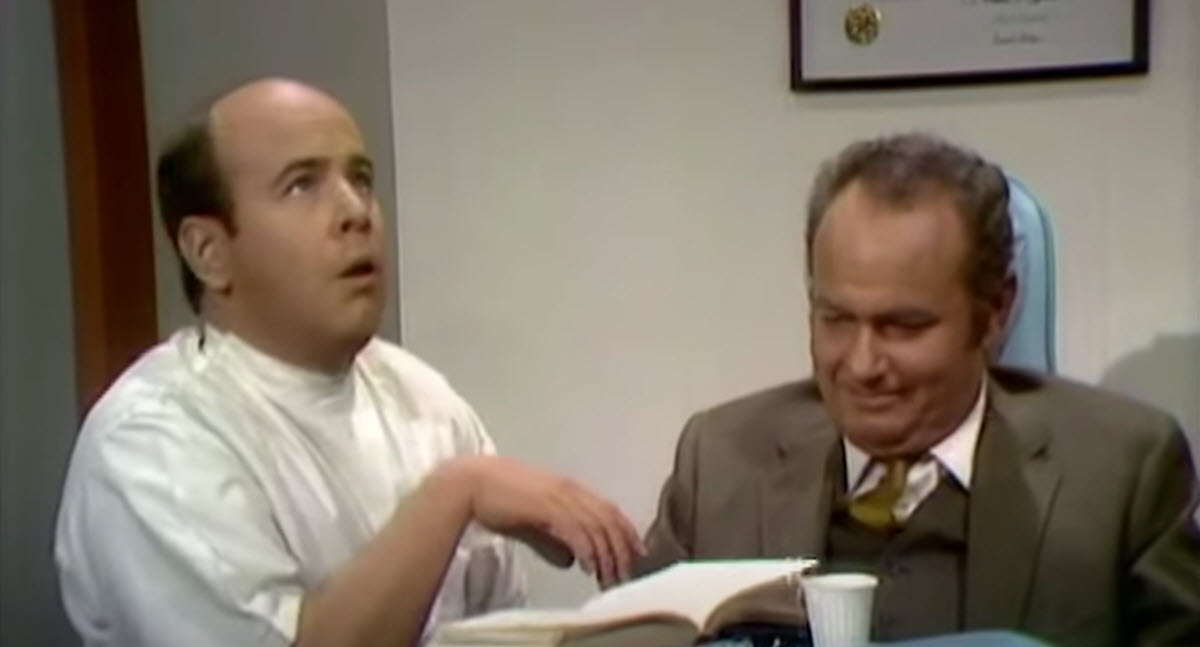
One such moment unfolded on The Carol Burnett Show, during a sketch that has since become legendary: the “Dentist Sketch.” At the center of it all were two comedic giants, Tim Conway and Harvey Korman, whose chemistry and unpredictability created a scene that still leaves audiences in stitches today.

The premise of the sketch was simple enough.
Conway played a nervous, inexperienced dentist tasked with performing a routine procedure.
Korman, portraying the patient, sat in the chair, expecting a standard comedic exchange.
But what made the moment unforgettable wasn’t the script—it was what happened when Conway went off it entirely.
As the sketch began, Conway leaned into his character’s anxiety, fumbling with tools and hesitating with every move.
The audience chuckled, sensing the tension building.
Then came the turning point: Conway’s character accidentally injected himself with Novocain instead of the patient. What followed was not just comedy—it was improvisational brilliance.
Conway began to lose control of his body in exaggerated, unpredictable ways.
First, his arm went limp, forcing him to awkwardly switch hands.
Then his leg buckled beneath him, nearly sending him to the floor.
His face contorted into a frozen expression, as though the numbness had spread everywhere at once.
Each movement was more absurd than the last, and none of it was entirely planned.
For Korman, the challenge was clear: stay in character. But that proved impossible.
“You could see him shaking,” Conway later recalled in interviews, reflecting on the moment.
And indeed, viewers could. Korman’s lips trembled, his eyes watered, and his composure slowly unraveled.
He tried to look away, to suppress the laughter, but Conway kept escalating the bit—pushing further into chaos with every passing second.

Then it happened. Korman broke.
The laughter wasn’t subtle. It was explosive, uncontrollable, and completely genuine.
He doubled over in the chair, unable to deliver his lines, while Conway—ever the instigator—continued the routine as if nothing was wrong.
The contrast only made the moment funnier.
Behind the scenes, Carol Burnett herself struggled to keep it together.
Unable to contain her laughter, she reportedly ran offstage to avoid derailing the sketch even further.
The audience, witnessing the unraveling in real time, erupted into roaring laughter.
What had started as a scripted segment quickly transformed into something far more powerful: a shared moment of pure, unscripted joy.
What makes the “Dentist Sketch” so enduring is not just its humor, but its authenticity.
In an era where television was carefully rehearsed and tightly controlled, this moment stood out as something raw and unpredictable.
It reminded viewers that even the most seasoned professionals could be caught off guard—and that sometimes, the best comedy happens when things don’t go according to plan.
Conway was known for this kind of comedic mischief.
Throughout his time on The Carol Burnett Show, he developed a reputation for pushing his fellow cast members to the brink.
He delighted in improvisation, often adding unexpected twists designed to provoke laughter—not just from the audience, but from his colleagues as well.
And while many actors might have found this disruptive, Korman embraced it, even if it meant losing control on camera.
Their partnership became one of the defining elements of the show.
Week after week, audiences tuned in not just for the sketches themselves, but for the possibility that something might go hilariously wrong.
There was a sense of anticipation, a shared understanding that when Conway and Korman were together, anything could happen.
The “Dentist Sketch” captured that magic perfectly. It wasn’t polished or precise—it was messy, chaotic, and wonderfully human.
And that’s exactly why it has endured.
Decades later, the clip continues to circulate online, introducing new generations to a moment that feels just as fresh as it did when it first aired.
In a world of carefully curated content and scripted perfection, the sketch serves as a reminder of the power of spontaneity.
It shows that laughter doesn’t always come from perfection—it often comes from the unexpected, the unplanned, and the uncontrollable.
For Conway, the moment was just another example of his comedic philosophy: keep things loose, stay present, and never be afraid to take risks.
For Korman, it was a testament to his professionalism—and his humanity.
Despite his best efforts, he couldn’t hold it together.

And in that failure, he helped create one of the most beloved moments in television history.
Ultimately, the legacy of the “Dentist Sketch” goes beyond laughter.
It represents a unique era of comedy, where performers trusted each other enough to embrace the unknown.
It highlights the importance of chemistry, timing, and the willingness to let go.
Most of all, it reminds us why we laugh in the first place.
Because sometimes, the funniest moments aren’t the ones we plan—they’re the ones that catch us completely by surprise.


