
A NIGHT WHEN EVERYTHING FELL APART ON LIVE TV — AND BECAME COMEDY HISTORY
In the long and colorful history of American television, few moments have achieved the kind of legendary status as the night Tim Conway completely derailed a sketch and sent Harvey Korman into uncontrollable laughter on The Carol Burnett Show. What unfolded on that stage was not just a comedy routine—it was a rare, unscripted explosion of spontaneity that turned into one of the most beloved bloopers ever broadcast.
The sketch itself began with a straightforward premise: a routine exchange between undercover detectives. It was structured, rehearsed, and designed to deliver laughs in a controlled, professional rhythm. But that structure didn’t last long. Almost immediately, Tim Conway began drifting away from the script, introducing bizarre, unexpected lines that no one else saw coming. His delivery was calm, almost innocent—but the absurdity of what he was saying kept escalating, layer by layer.
Conway had a unique comedic gift: the ability to stretch a joke far beyond its expected limit without losing its internal logic. Each new line didn’t just add humor—it raised the stakes. His improvisation wasn’t random; it was deliberate chaos, crafted in real time. And standing directly in its path was Harvey Korman, a seasoned performer known for his composure and impeccable timing.
At first, Korman tried to stay in character. You can see it in his posture, in the tension on his face, in the way he attempts to push through his lines. But Conway’s relentless improvisation chipped away at that control. A smirk broke through. Then a laugh. And within moments, Korman was completely undone—doubling over, turning away from the camera, gasping for air as he tried, and failed, to recover.
What happened next transformed the sketch into something unforgettable. The laughter became contagious. It spread beyond the actors, beyond the scene itself. The camera operators struggled to keep steady. The crew behind the scenes reportedly lost composure. Even Carol Burnett, the show’s iconic host, was said to be in tears from laughing offstage.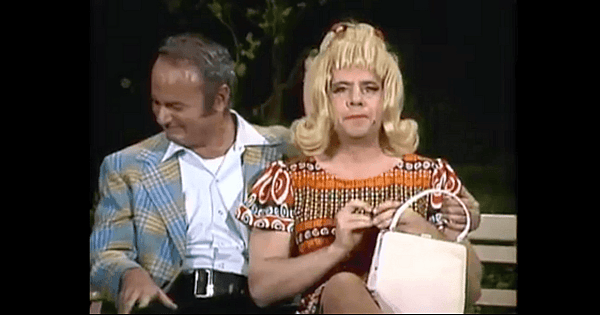
And yet, the cameras kept rolling.
In an era where television often prioritized polish and perfection, this moment stood out precisely because it was neither. It was raw. Unfiltered. Completely human. Instead of cutting away or reshooting, the production allowed the chaos to unfold, capturing something audiences rarely get to see: performers breaking character, not out of error, but because the moment itself became too funny to contain.
For viewers at home, it was electric. They weren’t just watching a scripted sketch—they were witnessing something real happening in real time. The boundary between actor and character dissolved, replaced by genuine reactions and uncontrollable joy. It created a connection that scripted comedy often struggles to achieve.
Decades later, the clip continues to circulate widely, gaining new audiences across generations. In a modern entertainment landscape dominated by tightly edited content and algorithm-driven humor, this moment feels almost revolutionary. It serves as a reminder that some of the most powerful comedic experiences don’t come from perfect writing, but from unpredictability and authenticity.
From a technical standpoint, the scene is often cited as a masterclass in comedic timing—but not in the traditional sense. Tim Conway demonstrated that timing isn’t just about delivering punchlines on cue; it’s about sensing the room, reading your fellow performers, and knowing exactly how far you can push a moment before it breaks. And in this case, breaking it was exactly what made it brilliant.
Harvey Korman’s reaction, though unintended, became an essential part of the performance. His inability to hold it together didn’t weaken the sketch—it elevated it. The contrast between Conway’s straight-faced absurdity and Korman’s visible collapse created a dynamic that no script could have replicated.
Ultimately, what makes this moment endure is not just the laughter, but the freedom it represents. For a few minutes, structure gave way to spontaneity. Control gave way to instinct. And in that space, something extraordinary happened—something that continues to resonate with audiences long after the laughter fades.
Because sometimes, the funniest moments aren’t written.
They simply happen.


